If you have ever stood near a laser running acrylic or metal, you know the smell.
Sharp. Chemical. Sometimes sweet. Sometimes metallic.
And the natural question follows:
Is that just unpleasant — or is it a problem?
Laser cutting fumes are not random odors. They are airborne byproducts created when high-energy lasers vaporize material. What you smell is often a mix of ultrafine particles and gaseous compounds released during the cutting process.
The real issue is not the smell itself, but what is in the air.
What Happens When a Laser Cuts Materials
When a laser beam hits metal, plastic, or coated surfaces, it:
- Rapidly heats the material
- Vaporizes part of it
- Creates microscopic particles
- Releases chemical gases
Those byproducts do not disappear. They cool, condense, and disperse into the surrounding air. Some become visible haze, but most remain invisible. That is why laser cutting fumes can travel well beyond the machine.
Why Acrylic Smells Stronger Than Metal
Metal cutting produces fine particulates like metal oxides, however acrylic and other plastics are different.
When acrylic (PMMA) is laser cut, it releases vaporized organic compounds. Those gases are what create the strong, persistent odor many operators notice immediately.
The smell does not necessarily mean the concentration is dangerous. But it does indicate airborne chemical presence. And airborne chemicals in enclosed environments should not be ignored.
Do Laser Cutting Fumes Go Away on Their Own?
Sometimes.
If the facility has strong ventilation and limited cutting volume, fumes may dissipate quickly.
But in high-production environments:
- Multiple machines operate simultaneously
- Air recirculates through HVAC systems
- Ceiling height slows contaminant removal
- Operations run multiple shifts
In those conditions, laser cutting fumes accumulate gradually.
You may not notice it at first. But over time, you do.
Source Capture Helps But Is Not Always Enough
Most laser cutters use localized extraction systems. That is good practice.
However:
- Capture hoods are not 100% efficient
- Material handling releases residual fumes
- Adjacent operations introduce additional emissions
- Gaseous compounds travel farther than particles
When fumes are noticeable outside the immediate cutting area, the issue becomes environmental rather than localized.
That is where ambient air systems enter the conversation.
When Source Capture Isn’t Enough
If laser cutting fumes move beyond the cutting table, it’s no longer a localized issue.
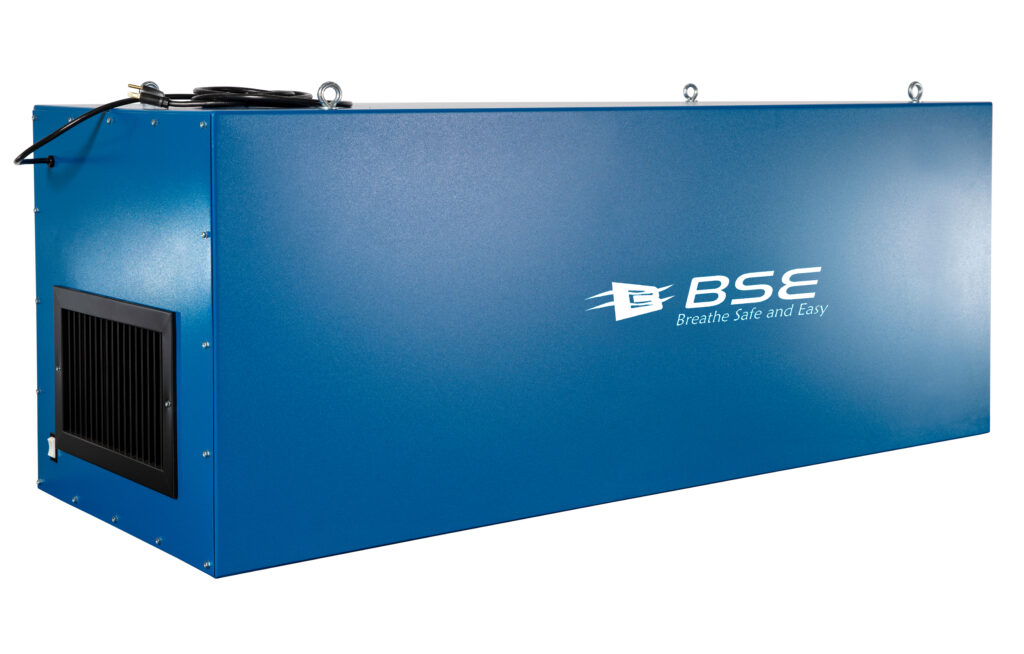
That’s where facility-wide ambient air systems come in. BSE’s ambient solutions continuously cycle and clean the air across your entire space — not just at the source.